
Applications are open for Posture in Motion.
A small-group posture and somatic practice for people who want to feel more at home in their body, move with more ease, and begin shifting the patterns that keep them tense, braced, or in pain. Apply here: https://hedishah.com/posture-in-motion/
“Why are all my injuries happening on one side of my body?” That was the question I kept asking after my car accident.
Literally everything was happening on the right side of my body:
jaw pain
neck pain
shoulder pain
foot pain
even eye pressure
I kept bringing it up to my medical team, my physio, and my chiro (and my kinesiologist, at one point), and they had no answer for me.
Even before my car accident, I always felt like something was off on my right side in single-leg exercises like lunges, split squats, etc.
A couple of years later, after being in constant chronic pain, through the postural restoration lens, I learned that my body was completely oriented toward the right side. Not because I’m unique, but because I’m human. It’s a pattern so many of us have, but mine got to an uncomfortable level after my car accident.
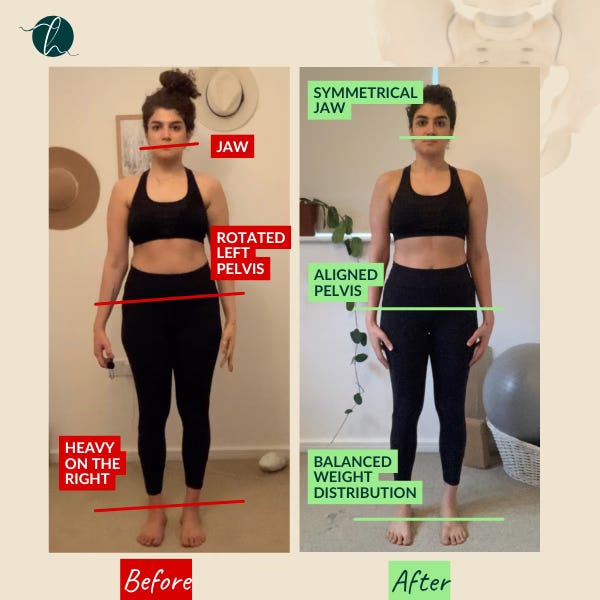
Here’s why the majority of humans are oriented toward the right:
Our heart sits in the left side of the rib cage, while more weight and organs are packed on the right, including the liver, colon, gallbladder, and more lung tissue.
Our inhale and exhale are different on the left and right. To be specific: the left ribs descend more easily because nothing is blocking them. On the right side, descending can be harder, but ascending is easier, and we have more respiratory capacity.
Usually, this orientation isn’t a problem. It becomes one after a significant injury, chronic stress, or anything else intensifies the pattern enough to cause discomfort.
Here’s what I did that made the biggest difference for me:
Step 1: Improve breathing mechanics
I began learning how to breathe through my diaphragm again. Not in a forced “take a deep breath” way, but in a way that helped my ribs, pelvis, and nervous system remember how to move together. This became the foundation for everything else because if my breath was still stuck in the same old pattern, my body would keep organizing itself around that pattern too.
Step 2: Sense the left side
I began re-learning how to use my left side. Through sensation and breath, I gave my brain and body access to a side I’d stopped trusting, so I could gradually shift out of the right-dominant pattern I kept defaulting to. This exercise helped me feel my left heel, left inner thigh, left hamstring, and left-side abs again, so I didn’t keep relying on my right side when I stood, walked, breathed, or exercised.
Step 3: Use my right side butt to shift weight into my left side
Healthy posture lets you shift your weight easily from side to side. Once I had a better sensory connection to my left, I still needed to learn how to shift from right to left. This exercise helped me practice that in a safe, supported position.
Step 4: Get my core to actually work
Once my breath and left side started coming back online, the next piece was helping my core do its actual job. Not bracing, gripping, or holding everything tight, but creating enough support through my ribs, pelvis, and deep abdominal system that the rest of my body didn’t have to overcompensate. When my core started working in this more integrated way, my shoulder, neck, jaw, and hip didn’t have to keep carrying the load for me.
If you keep experiencing pain or injuries on one side of your body, it is not random.
Your body has learned a pattern: a way of standing, breathing, shifting, bracing, or protecting that once made sense, but now keeps you stuck in the same loop.
Your body needs more options than one repeated strategy, so you’re not always relying on the same side to get through the day.
This is the work we’ll explore inside Posture in Motion: understanding the patterns behind your posture, pain, and movement habits, and learning how to shift them from the root.
Applications are open here: https://hedishah.com/posture-in-motion/
Thank you for joining me on the path of unconditioning,
––––––––––––––––––
Hedi Shah
––––––––––––––––––
👁️ Mindfulness Teacher & Bodyworker
🐉 Nervous system regulation, breathwork, and posture-focused strength training to target the cause of what keeps you stuck and in pain, not just symptoms.
📲 Website | Youtube | LinkedIn | Insight Timer